The Unbreakable Bond That Defines Men, Families, and Humanity
Introduction: What is Brotherhood?
If parenthood is about giving life, brotherhood is about giving meaning to life. It is one of the oldest, deepest, and most powerful forms of human connection. Long before nations, religions, or armies, there were brothers.
Brotherhood is not just a biological relationship. It is a code. A promise that says: “I got your back, no matter what.” It exists in blood, but it also exists in battlefields, locker rooms, hostels, monasteries, workshops, and in the quiet look between two friends who have seen each other fail and still stayed.
In a world that teaches men to be competitive, to hide emotions, and to be self-sufficient, brotherhood is the rebellion. It is the permission to be vulnerable, to belong, and to be stronger together than alone.
1. The Three Faces of Brotherhood
Brotherhood shows up in three distinct forms in every man’s life.
A. Brotherhood by Blood
This is the brother you grew up fighting with over the TV remote. The one who knows your childhood secrets, your mother’s scolding style, and exactly which button to push to make you angry. Blood brotherhood is involuntary — you don’t choose it, but you learn to cherish it.
Psychologists say sibling brotherhood is the longest relationship most people will ever have — longer than with parents, spouses, or even children. You start together in childhood chaos, you drift in your 20s when life pulls you apart, and if you are lucky, you return in your 30s and 40s as friends. The rivalry fades, the loyalty remains.
Blood brothers teach you conflict resolution, sharing (even when you don’t want to), and unconditional belonging. You may not talk every day, but one phone call — “I need you” — and he is there.
B. Brotherhood by Choice — The Chosen Family
This is the most powerful form in modern life. These are friends who became family. College roommates, childhood friends from the gali, colleagues who turned into brothers, gym partners.
Chosen brotherhood is voluntary. You select each other through shared values, not shared DNA. It is built on shared suffering — exams, heartbreaks, night shifts, business failures, treks where you thought you would die. The bond is forged in the fire of shared experience.
In India, we call it “yaari,” “bhai-chara.” In the West, it’s “bromance” — but it’s deeper than that. It is the man who will lend you money without a receipt, who will sit with you in the hospital all night, who will tell you the truth when everyone else is flattering you.
C. Brotherhood by Cause — The Sacred Bond
This is the brotherhood of soldiers, of fraternities, of monks, of social movements, of teams. When men commit to a mission bigger than themselves, brotherhood is born.
This is why army veterans say, “I would die for my brother.” They are not being dramatic. In the Kargil War, in World War II, in every battlefield, men did not fight for the flag first — they fought for the man next to them. The flag was abstract. The brother next to them was real.
The same applies to sports teams, to startups, to bikers clubs, to spiritual groups like the Ramakrishna Mission or Freemasons. A common uniform, a common oath, a common enemy — these create a brotherhood that can last a lifetime.
2. The Psychology of Brotherhood: Why Men Need It
For decades, men were told to be lone wolves. Science now says lone wolves die early.
A Harvard study that tracked men for 80+ years found that the single biggest predictor of happiness and health at age 80 was not money, fame, or achievement — it was the quality of close relationships. Brotherhood literally keeps men alive.
What brotherhood does to the male brain:
- Reduces Cortisol: Just being with a trusted brother-friend lowers stress hormones.
- Increases Accountability: You are 95% more likely to achieve a goal if you have a brother holding you accountable.
- Provides Emotional Regulation: Men often co-regulate emotions through side-by-side activities (driving, playing, gym) rather than face-to-face talking like women. Brotherhood provides that safe side-by-side space.
- Prevents Loneliness Epidemic: In 2026, male loneliness is a global health crisis. 1 in 3 men say they have no close friends. Brotherhood is the antidote.
Real brotherhood allows a man to say three things he rarely says elsewhere: “I don’t know,” “I need help,” and “I’m scared.” And not be judged for it.
3. Brotherhood Across Cultures and History
Every culture has revered brotherhood.
In the Mahabharata, the Pandavas’ brotherhood is tested by exile, war, and dharma. Despite flaws and fights, they never break their vow to stand together. In the Ramayana, Bharata’s brotherhood to Rama is so pure that he refuses the throne and places Rama’s sandals on it — the ultimate symbol of loyalty.
In ancient Greece, the Sacred Band of Thebes was an army of 150 pairs of male lovers/brothers — they believed a man would fight harder to not shame his beloved brother in battle. They were undefeated for decades.
In modern pop culture, from Sholay’s Jai-Veeru to 3 Idiots Rancho-Farhan-Raju, we celebrate yaari because we know life without brotherhood is just survival, not living.
Islam speaks of “Ummah” — global brotherhood. Christianity says “love one another as brothers.” Sikhism’s concept of “Khalsa” is a brotherhood of saints and soldiers.
4. The Code of Real Brotherhood
Not every male friendship is brotherhood. Brotherhood has a code. An unwritten dharma.
- Loyalty Over Convenience: A brother stands with you when it is inconvenient, unprofitable, and unpopular.
- Truth Over Flattery: A friend will tell you what you want to hear. A brother tells you what you need to hear. “Bhai, tu galat hai is baar.”
- Confidentiality is Sacred: What is said in brotherhood, stays in brotherhood.
- Celebrate, Don’t Compete: Jealousy kills brotherhood. Real brothers are happy when you win — promotion, girl, house. No scoreboard.
- Show Up: Brotherhood is not about big speeches. It is about showing up. At the funeral, at the hospital, at the airport at 3 AM.
- No Ghosting: Brothers fight, but they don’t disappear. Silence is discussed, not used as punishment.
5. Brotherhood in the Age of Social Media
We have 1000 followers but do we have one brother we can call at 2 AM? Likes are not loyalty. Comments are not commitment.
The modern challenge is to move from digital connection to real connection. That means:
- Weekly calls, not just memes.
- Meeting in person, not just on Discord.
- Doing hard things together — trek, build, volunteer, train.
A true brotherhood circle in 2026 has 3-5 men. Not 50. Quality over quantity.
6. How to Build and Keep Brotherhood
Brotherhood doesn’t happen; it is built intentionally.
Step 1: Find Your Tribe: Look for shared values, not just shared interests. Do his actions match his words?
Step 2: Create Rituals: Our ancestors had rituals — hunting together, praying together. Create your own: Monday gym, Sunday chai, monthly trek, annual trip without families.
Step 3: Be Vulnerable First: You want deep friendship? Go first. Share a fear, a failure. Vulnerability is the invitation.
Step 4: Forgive Quickly: Brothers will hurt you. Unintentionally. Talk it out. Ego is the biggest killer of brotherhood.
Step 5: Invest When It’s Hard: Relationships are like bank accounts. You must deposit before you can withdraw. Deposit time, help, and attention when there is no need, so it is there when there is need.
7. When Brotherhood Breaks
Sometimes brotherhood breaks — over property, money, women, ego, politics. Blood brothers who don’t talk for 10 years over ancestral land is tragically common in India.
If your brotherhood is broken:
- Ask: Is this a misunderstanding or a value mismatch? Misunderstandings can be fixed. Value mismatches cannot.
- The elder or more mature one must reach out first. Always.
- Write a letter if talking is hard. “I miss our brotherhood.”
- If it is toxic — constant disrespect, manipulation — it is okay to walk away from blood to protect peace. You can love someone from a distance.
TABLE 1: Types of Brotherhood and Their Core Characteristics
| Type of Brotherhood | How It Forms | Strength | Biggest Test | Lifespan |
| Blood Brotherhood | Birth / Family | Unconditional, lifelong identity | Property, Parental comparison, Ego | Lifetime, often longest relationship |
| Chosen Brotherhood (Yaari) | Shared time, suffering, values | Voluntary, deep trust, chosen family | Distance, Money, Success/Jealousy | 10-40+ years if nurtured |
| Cause / Mission Brotherhood | Shared mission, uniform, oath | Intense, high loyalty under pressure | End of mission, Betrayal of cause | Intense during mission, can fade after unless ritualized |
| Spiritual Brotherhood | Shared guru, faith, path | Compassionate, ego-less, service-based | Dogma, Guru change | Can be lifetime if values align |
TABLE 2: Brotherhood vs. Regular Friendship – The Real Difference
| Aspect | Regular Male Friendship | True Brotherhood |
| Communication | Memes, occasional hi-hello, party plans | 2 AM calls, uncomfortable truths, silence is okay |
| Conflict Style | Avoids fight, ghosts, passive | Fights, resolves, comes closer |
| In Need | “Let me know if you need anything” | Shows up without being asked, “I’m coming” |
| Success | Slight jealousy, comparison | Genuine pride, “My brother won” |
| Loyalty | With you when it’s fun | With you when it’s costly, boring, or risky |
Conclusion: The Return to Brotherhood
In a world that is increasingly isolated, polarized, and digital, brotherhood is not a luxury — it is a necessity. It is the anchor that keeps men from drifting.
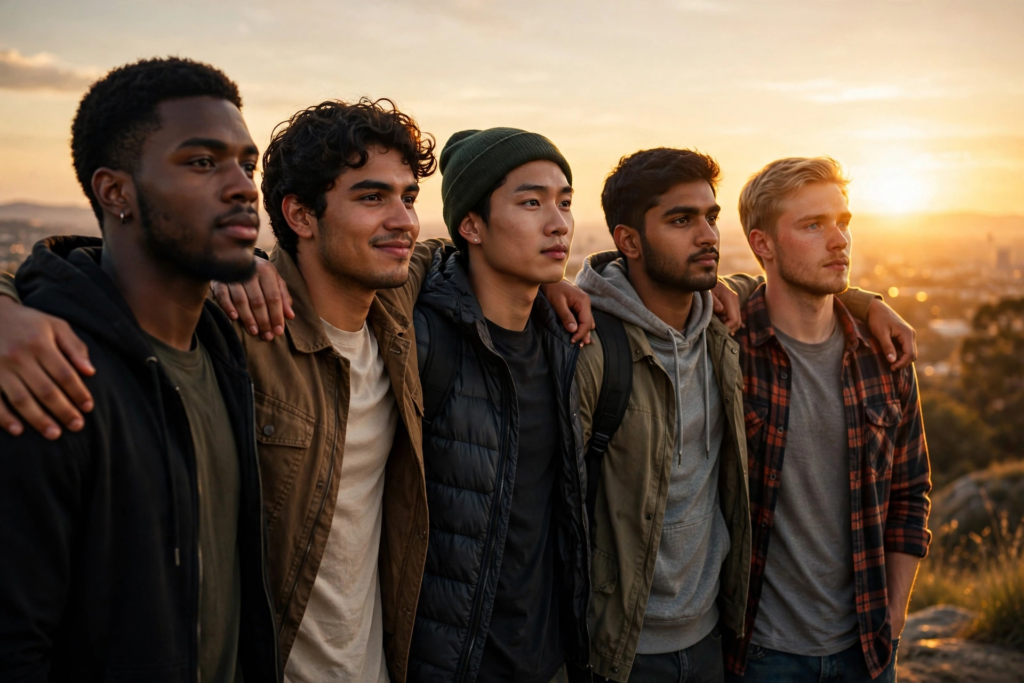
Look at the three images above: the friends watching the sunset together — that’s your chosen family, dreaming of a future. The two young brothers on the couch — that’s your blood, your first best friend. The soldiers holding a wounded comrade — that’s the ultimate code: we leave no one behind.
If you are a man reading this, you need to do three things today:
- Call your blood brother. Just say, “Miss you, bhai.”
- Message your chosen brother. Fix a time to meet, not just chat.
- Be a brother to someone who needs one.
Because at the end of life, no one will remember how much money you made or how many followers you had. They will remember if you were a good brother. And if you had good brothers beside you.
Brotherhood is not about being blood-related. It is about bleeding for each other when needed. That is the only definition that matters.