The First Team, The Last Shelter, The Forever Home
Introduction: What is Family?
Family is not an important thing. It is everything.
We come into this world through family, we learn language through family, we learn love, conflict, sharing, jealousy, forgiveness — all through family. Long before schools, governments, or religions existed, there was family.
In 2026, the shape of family has changed. We have nuclear families, joint families, single-parent families, blended families, chosen families, LGBTQ+ families, and long-distance families on video calls. The shape has changed, but the soul has not.
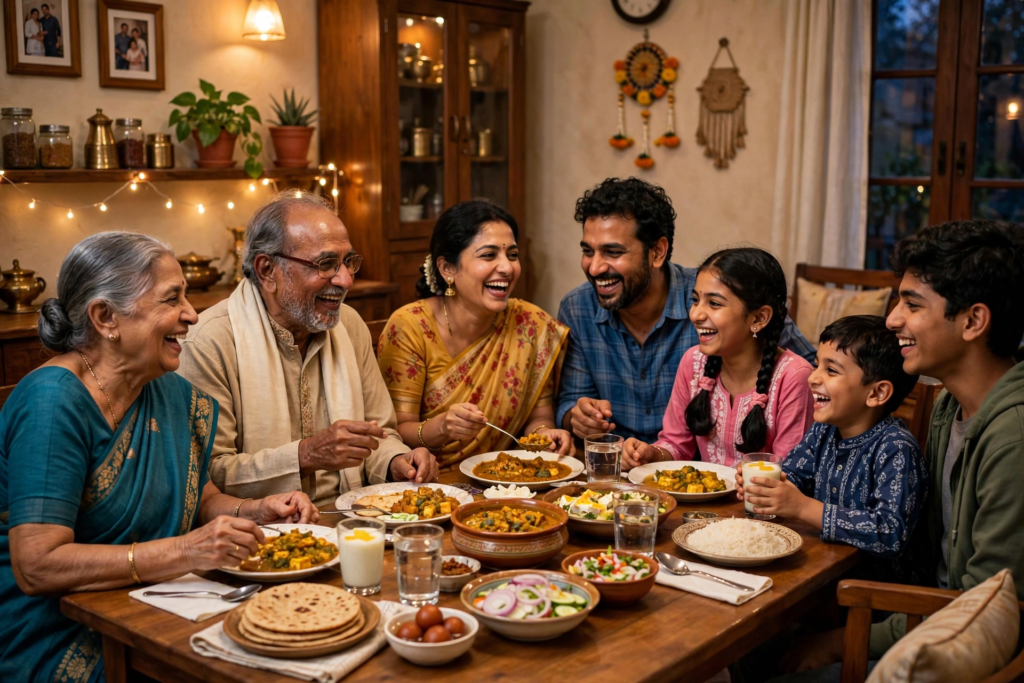
Family is the people who know your story from the beginning and will still be there to hear the end. It is the Indian joint family laughing over dinner with grandparents serving food, the nuclear family of four hiking a mountain trail holding hands, and the family sitting close on a sofa comforting an elderly grandmother who is grieving.
If childhood is the foundation, family is the whole house.
1. The True Meaning of Family
The dictionary says family is “a group related by blood or marriage.” That definition is incomplete.
A better definition: Family is a system of unconditional belonging where your absence is felt, not just your presence.
Family does three jobs that no other institution can do as well:
1. Safety: In a world that judges you, family is supposed to be the place where you are safe to fail. A child falls, family catches. An adult loses a job, family holds.
2. Identity: Your surname, your language, your food habits, your festivals, your values — family gives you your first identity. “We are the kind of people who…” — that sentence comes from family.
3. Continuity: Family is the bridge between past and future. Grandparents tell stories of where you came from, parents show where you are, children show where you are going. Without family, we are rootless.
2. Types of Families in Modern India
India is unique — we live in many types of families at once.
a) Joint Family: Grandparents, uncles, aunts, cousins under one roof. The Indian family dinner image is this. Strength: shared resources, built-in childcare, less loneliness. Challenge: less privacy, generational conflict, property disputes.
b) Nuclear Family: Mother, father, kids. Most common in cities now. Strength: independence, decision-making freedom. Challenge: loneliness, high pressure on two parents, no backup.
c) Blended / Step Family: After divorce or remarriage. Two families merging. Needs extra patience and clear boundaries.
d) Single-Parent Family: One mother or father raising kids. One of the toughest and most courageous forms. Needs community support.
e) Chosen Family: Friends who become family. Especially important for people who move to cities for work, or whose blood family is toxic. Your chosen family is the people you call at 2 AM.
All are valid. What makes a family is not blood, but bond and commitment.
3. The 5 Pillars of a Strong Family
After studying happy families for 50 years, researchers found they all do 5 things:
Pillar 1: Rituals
Not just routine, but rituals. Sunday biryani, Friday movie night, annual Diwali photo, bedtime story. Rituals give children security and adults memory anchors.
Pillar 2: Communication
Happy families talk openly, not perfectly. They have family meetings, they say “I feel…” instead of “You always…”. The hiking family in the mountains — they are talking, looking at each other, disconnected from phones. That is communication.
Pillar 3: Support in Crisis
Anyone can celebrate with you. Family shows its truth in crisis. The image of four generations comforting a grieving grandmother on a sofa — that is the real test of family. Will you sit with someone in pain without trying to fix it immediately?
Pillar 4: Boundaries + Togetherness
Healthy families balance “we” and “me”. Too much togetherness = suffocation. Too much independence = disconnection. Good families allow privacy, different opinions, and personal space.
Pillar 5: Shared Values, Not Shared Views
You don’t need to agree on everything — politics, career, food. But you need shared core values: respect, honesty, loyalty, kindness. Values hold, views can differ.
4. Why Family Is Struggling in 2026
- Time Poverty: Both parents working, kids in tuition, no time for dinner together. The average Indian family eats together less than 4 times a week now.
- Screen Intrusion: Phones at dinner table. Family in same room, but each in different digital world.
- Migration: Children move to US, Canada, Bangalore for jobs. Parents left behind in hometown. Video call is not a hug.
- Comparison Culture: Instagram shows perfect families. Real families have fights, dirty dishes, and silent treatments. Comparison breeds shame.
- Ego over Forgiveness: Small fights become 5-year silences because no one says sorry first.
5. How to Build a Happy Family (Practical, Not Preachy)
- Eat Together, No Phones: At least 5 dinners a week, phones in another room. This one habit improves children’s grades and reduces teenage depression.
- The 10-Minute Rule: Every family member gets 10 minutes daily of undivided attention from one other member. No advice, just listening.
- Create a Family Motto: “In this family, we help, we try, we forgive.” Write it on a wall.
- Apologize Fast: Parents who apologize to kids raise emotionally secure kids. “I shouted, that was wrong. I’m sorry.”
- Celebrate Small Wins: First cycle without training wheels, first salary, fixing a tap. Celebrate loudly.
- Hold Family Meetings: 20 mins every Sunday. What went well? What was hard? What next week?
- Touch: A daily hug. A pat on back. Grandmother’s hand held. Physical touch regulates nervous systems.

TABLE 1: Joint Family vs Nuclear Family – Honest Comparison
| Aspect | Joint Family | Nuclear Family |
| Support System | High – many caregivers, shared work, less loneliness for elders/kids | Low – only 2 adults doing everything, high burnout risk |
| Privacy & Freedom | Low – many opinions, less personal space, decisions need consensus | High – full freedom to decide, live by own rules |
| Financial Load | Shared – expenses divided, more savings buffer | Entirely on 1-2 earners, more pressure during job loss |
| Child Development | Kids learn sharing, adjusting, respect for elders from young age | Kids more independent, but may miss social skills of large group |
| Conflict Style | Frequent small conflicts, but quick resolution (can’t avoid each other) | Less frequent conflict, but can become big silent distance |
TABLE 2: Signs of Healthy vs Struggling Family
| Area | Healthy Family | Struggling Family |
| Communication | Talks openly, can disagree respectfully, says “I feel” | Shouts, silent treatment, sarcasm, secrets, talks about not to |
| Rules | Clear, consistent, explained, flexible with age | Either too rigid (authoritarian) or no rules at all (chaotic) |
| Emotions | All feelings allowed: joy, anger, sadness can be expressed safely | Only happiness allowed, anger/sadness punished or mocked |
| Crisis Handling | Comes together, supports weakest member, asks for outside help | Blames, isolates, hides problems, “log kya kahenge” fear |
| Love Expression | Shown daily through actions, words, hugs, service | Assumed but rarely shown – “We know we love, why say it?” |
Conclusion: Family is a Verb, Not a Noun
Family is not something you have. It is something you do. Every day.
It is the choice to have dinner together when you are tired. To hike a mountain together when kids would rather play games. To sit close and hold a grieving grandmother’s hand when you have work pending.
You will not remember the days your house was perfectly clean. You will remember the dinner laughter, the mountain hike where your daughter held your hand tightly, and the evening your whole family sat together and just cried and comforted.
Blood makes you related. Choice, effort, forgiveness, and showing up — that makes you family.
If you are reading this far from home, call your family today. If you are with them, put your phone down and hug them. That hug is your real wealth.