The Most Powerful, Private, and Permanent Friendship

Introduction: What Sisterhood Really Means
If brotherhood is about standing shoulder-to-shoulder, sisterhood is about standing heart-to-heart. It is the first female friendship most girls ever have, the first rival, the first secret-keeper, the first therapist, and often, the last friend standing.
Sisterhood is not just biology. Like brotherhood, it has three forms: blood, choice, and cause. Blood sisters share a womb, a home, and a childhood. Chosen sisters — your best friends who become sisters — share your heart. And cause sisters — women who unite for empowerment, motherhood, business, or healing — share a mission.
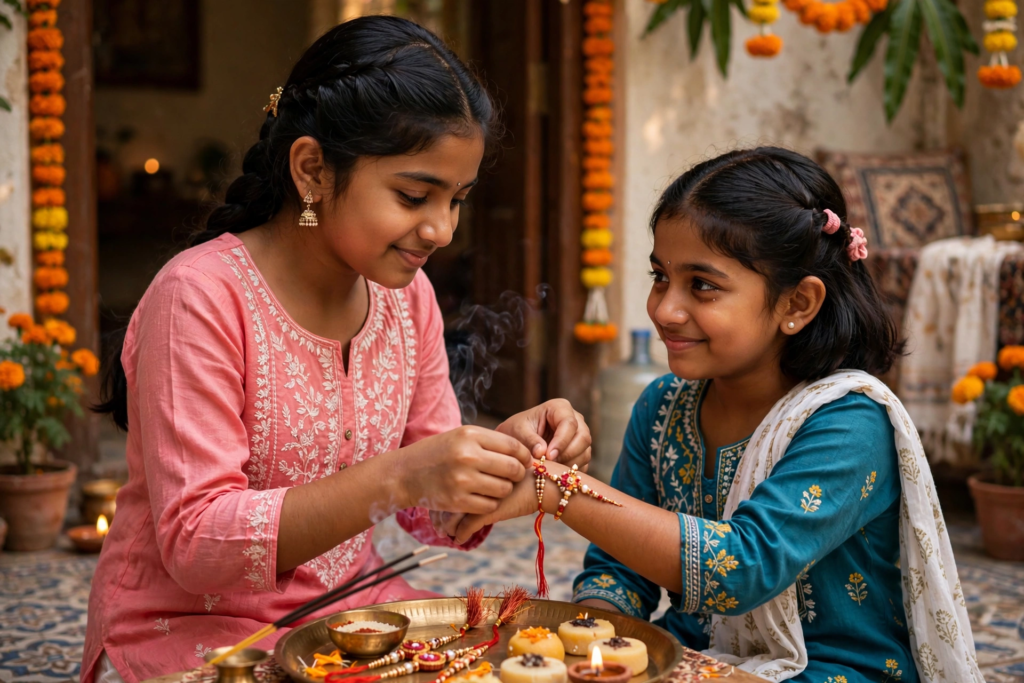
In India, sisterhood has a festival: Raksha Bandhan. But sisterhood doesn’t need a festival to exist. It exists in two girls laughing on a bed full of polaroids and fairy lights, in two young sisters tying a handmade rakhi on a decorated aangan, and in two grown women holding each other on a sofa while one cries.
If you have a sister, you have a mirror and a shadow for life. She has seen you at your most childish and your most broken, and she still chooses you.
1. The Psychology of Sisterhood
Research shows sister relationships are unique.
- Sisters make you more empathetic: A Brigham Young University study found that having a sister — even a younger sister — makes you more likely to be kind, generous, and empathetic, regardless of age gap.
- Sisters are your first conflict-resolution training: Fighting over clothes, over bathroom time, over who mom loves more — these petty fights teach negotiation, forgiveness, and boundaries.
- Sisters protect mental health: Girls with sisters have lower rates of depression and higher self-esteem in adolescence. A sister is a buffer against loneliness and parental pressure.
- Sisterhood in adulthood is a health asset: Women with close sister-friends have 23% lower mortality risk. They talk face-to-face, co-regulate stress, and share emotional loads — something men often struggle to do.
Unlike brotherhood which is often side-by-side (playing, working), sisterhood is face-to-face: talking, crying, laughing, sharing.
2. The 5 Stages of Sisterhood
Stage 1: The Rivalry Stage (3-10 years)
“Mumma, she took my doll!” Jealousy, comparison, fights. Parents often make it worse by comparing: “See, your sister studies.” This is normal.
Stage 2: The Alliance Stage (11-18 years)
Teenage years. You become allies against parents, share secrets about crushes, borrow each other’s clothes without permission. The image of two teenage sisters laughing on a bed with journals and stickers — that’s this stage. Golden, giggly, inseparable.
Stage 3: The Distance Stage (18-28 years)
College, jobs, boyfriends, marriages, moving cities. Contact reduces. Life pulls you apart. Many sisters drift here.
Stage 4: The Return Stage (28-40 years)
Marriage, motherhood, loss, career failure — real life hits. You call your sister again. Not for gossip, but for wisdom. “How did you handle this?” The bond becomes adult.
Stage 5: The Rooted Stage (40+ years)
You become each other’s parents’ caregivers, family historians, and memory keepers. You are the only two people who remember your childhood home exactly the same way. This is the comforting sofa image — one sister holding the other through heartbreak, divorce, or grief. No judgment, just presence.
3. Sisterhood in Indian Culture
India understands sisterhood better than the West because we ritualize it.
Raksha Bandhan is not just about brother protecting sister. In many families now, sisters tie rakhi to sisters — a promise of mutual protection. The image of two sisters in pink and teal suits tying a beaded rakhi with marigold garlands behind them — that is modern India. It says, “I will protect you too.”
We have Draupadi and Krishna — a sister-brother bond not by blood but by choice. We have Sita and her sisters, the Navadurgas — nine forms of feminine power that are called sisters.
In villages, women form “sisterhoods” called Mahila Mandals, self-help groups — they save money together, fight domestic violence together, start businesses together. That is cause-sisterhood.
4. Chosen Sisterhood: When Friends Become Sisters
Blood makes you sisters, but loyalty makes you soul-sisters.
Chosen sisterhood is often stronger than blood because it is voluntary. You have no family pressure to love her — you just do. These are the friends who:
- Know your cycle dates and your trauma dates.
- Will come to your house without calling and open your fridge.
- Will tell you, “That man is not good for you,” even if you get angry.
- Will hold your hair when you vomit, and your hand at your wedding.
How to recognize a soul-sister? You can be ugly-crying in front of her and not feel ugly.
TABLE 1: Sisterhood vs Brotherhood – The Beautiful Difference
| Aspect | Brotherhood (General Pattern) | Sisterhood (General Pattern) |
| Bonding Style | Side-by-side: doing things together (play, work, mission) | Face-to-face: talking, sharing, emotional processing |
| Conflict | Direct fight, then quickly patched, less grudge | Can be indirect, emotional, needs long talk to repair |
| Support in Crisis | Shows support by fixing problem, distracting | Shows support by listening, validating, staying present |
| Communication | Less frequent, low maintenance, “I’m here if needed” | More frequent, high check-ins, daily updates expected |
| Expression of Love | Teasing, pranks, protective action | Compliments, hugs, deep talks, remembering details |
Note: These are general patterns, not rules. Every individual is different.
TABLE 2: Types of Sisterhood and What Each Gives You
| Type of Sisterhood | How It Forms | What It Gives You | Biggest Challenge |
| Blood Sister | Same parents, same home | Shared history, identity, family roots, lifelong mirror | Childhood rivalry, parental comparison, property disputes |
| Chosen Sister / Best Friend | Shared school, college, hostel, work, heartbreak | Chosen family, non-judgmental safe space, daily emotional support | Distance, life changes, jealousy if not nurtured |
| Cause Sisterhood | Women’s groups, motherhood, business, activism | Empowerment, collective strength, “you are not alone” feeling | Can break over ideology or competition |
| Spiritual / Mentor Sisterhood | Elder-younger female bond, guru-shishya, maasi-bhanji like | Guidance, wisdom, nurturing, mother-like support | Power imbalance if not handled with respect |
5. When Sisterhood Hurts – The Dark Side
Sisterhood is powerful, but it can wound deeply because expectations are high.
Common Wounds:
- Comparison by parents: “Why can’t you be like your sister?”
- Unequal caregiving burden: One sister does all the parent care.
- Money and inheritance.
- Feeling left out when one sister gets married and moves abroad.
How to Heal:
- Stop triangulating. Don’t talk about your sister to your mother. Talk to your sister.
- Create boundaries without guilt. “I love you, but I cannot take your call at 11 PM daily.”
- Celebrate differences. You don’t have to be the same to be close. One can be a doctor, one a dancer — both are worthy.
- Ritualize reconnection. Monthly sister date, no phones. Annual sister trip. Rakhi is not enough — make your own festivals.
6. How to Be a Good Sister (Whether by Blood or Choice)
- Keep her secrets like a locker. If she told you in confidence, it dies with you.
- Hype her in public, correct her in private.
- Remember her important dates. Not just birthdays, but interview, IVF, divorce hearing.
- Be her emergency contact, not just her party contact.
- Say sorry first. Ego has no place in sisterhood.
- Protect her name when she is not in the room.
Conclusion: A Sister is a Forever Home
A sister is both your childhood and your future. She is the only person who knows how your mother scolded, how your father laughed, and how your childhood home smelled during Diwali.
The two teenagers giggling on a bed will one day be two women in their 60s laughing about the same boy who never liked them back in school. The two little girls tying rakhi will one day tie each other’s children’s rakhis. The woman crying on the sofa will one day be the one holding.
If you have a sister — blood or chosen — call her today. Don’t wait for Rakhi, don’t wait for a reason. Just say, “I was writing about sisterhood and thought of you. Thank you for being my sister.”
Because in a world that keeps telling women to compete, sisterhood is the rebellion that says, “We rise together.”